Ads 468x60px

Showing posts with label BMW. Show all posts

Thursday, 10 May 2012

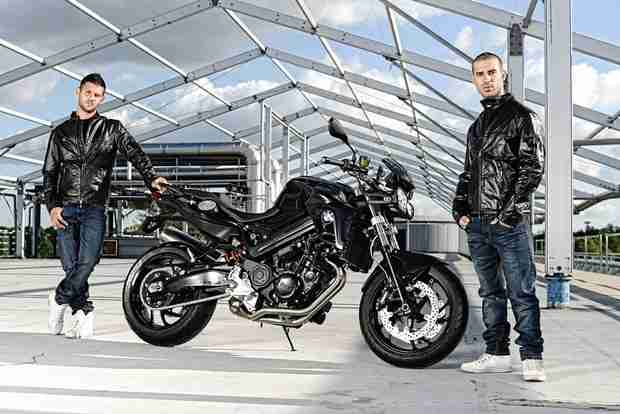
BMW F800R 2012 IN SPECIAL BLACK SAPPHIRE METALLIC PAINT-JOB


World Superbike stars Marco Melandri (BMW Motorrad Motorsport Team) and Michel Fabrizio (BMW Motorrad Italia GoldBet SBK Team) attended the launch of the BMW F800R with the brand new Black Sapphire Metallic paint-job.
This exclusive color scheme will be made available for Italian customers only, with no extra charge. The F800R is a well-balanced naked bike which is easy and fun to ride in urban traffic as well as on motorways, and comes with a 798 cc flat twin engine with electronic fuel injection delivering 87 hp and an impressive 86 Nm (63 ft-lb) of peak torque at 6,000 rpm, with a smooth delivery and good fuel consumption figures. Its comfortable and light chassis (the bike boasts a dry weight of just 177 kg) makes the bike agile enough to be easily ridden even by the less experienced riders. Check out the BMW F800R gallery for more photographs.
Other highlights of this model include standard ABS, TPC Tyre Pressure Control, 320 mm Brembo double disk brake at the front, heated grips, white turn indicators, a flat instrumentation screen (featuring digital clock, total and 2 trip odometers, cruising range indicator and service interval indicator) as well as new sports wind-shield in body colour.

BMW F800R BLACK METALLIC


The folks at Italy get a special exclusive BMW F800R Black Metallic edition.

Friday, 4 May 2012

WSBK 2012 MONZA: BMW MOTORRAD ITALIA GOLDBET SUPERBIKE TEAM QP REPORT


BMW Motorrad Italia GoldBet Superbike Team finished the first day at Monza positively by achieving first place in Qualifying 1 with Michel Fabrizio in Superbike and with Sylvain Barrier in Superstock 1000. Michel Fabrizio, after finishing in second place the morning’s Free Practice 1, improved his performance and got the first place at the end of Qualifying 1, thanks to a 1’42.327 lap time. Michel also recorded a maximum speed of 334.8 on the finishing straight today, equalling the speed record that was set last year on this track.
Ayrton Badovini, on the other hand, took fifth place in Qualifying 1 with a time of 1’42.690. He was particularly competitive in the second part of this afternoon’s qualifying after improving the feel of the front of the bike during the first half of the session with the help of technicians and engineers.
In the FIM Superstock 1000 Cup Sylvain Barrier and Lorenzo Baroni claimed first and third place respectively at the end of Qualifying 1, also taking provisional front row slost for the Sunday race. Barrier, just after setting the lap-time of 1’46.340 that gave him the first position, had a crash at the ‘Lesmo 2’ turn suffering a left shoulder dislocation which puts his participation in the next two days of racing in question.
Andrea Buzzoni – BMW Motorrad Italia GoldBet Superbike Team Director
“Today’s result sees four BMW riders in the first five spots, giving BMW Motorrad great satisfaction. Today’s performance proves the effectiveness of this programme and efforts from both the technical crew and riders. Today there was a clear demonstration of the competitiveness of this project and the commitment on a technical, human and financial side. Now we must keep our concentration high to achieve the next goal represented by the two Sunday races.”
Serafino Foti – BMW Motorrad Italia GoldBet Superbike Team Sporting Director
“It’s been a positive day as both Michel and Ayrton were quick right from the start and the team worked in a formidable way attitude-wise and made the right choices. We’re happy and we are enjoying today’s result, waiting to see what the weather has in store for us. We’re not completely happy with how the things went for the Superstock 1000 guys. The results match the expectations but Sylvain’s crash put his on-track participation in jeopardy”.
Michel Fabrizio #84 – FP1 2nd (1’43.049) – QP1 1st (1’42.327)
 ”I’m happy, after the bad luck experienced in race 2 at Assen and I have got my confidence back. I knew I could have been fast and I’m happy to have proven it on the track. We started in a good way this morning. We haven’t made any big change in the set-up as the one we found at Mugello seems to work well on very different track layouts. Now we just have to wait and see how the weather will turn out tomorrow, although the forecast predicts rain.”
Ayrton Badovini #86 – FP1 5th (1’43.893) – QP1 5th (1’42.690)
“Today went well. I managed to climb up some positions in the last part of qualifying after experiencing some lack of feeling at the front of my bike. Thanks to Dino and my crew I got back to a way of riding I like. I could even have got a better result but on my fast lap I was slowed down by a rider in front of me who made a mistake at “Variante Ascari”. We have found the right direction and because of that I can say I’m happy with the results.”

Friday, 27 April 2012

Face-off: BMW K1 vs K1300S


Face-off: BMW K1 vs K1300S


In 1989, the BMW K1 was probably the most radical sportstourer around...
Pics: 2Ri.de

First unveiled in September 1988 and launched in early 1989, the BMW K1 was a pretty radical machine. The bike weighed almost 280 kilos, but its 987cc liquid-cooled fuel-injected inline-four, which produced 100bhp and 100Nm of torque, could still push the K1 to a top speed of 230km/h. But, of course, it was the K1’s styling and technology that made it stand out from the crowd…

Between 1989 and 1993, BMW produced close to 7,000 units of the K1. The bike was expensive, costing US$12,990 back in 1990. But then this was a high-tech machine, with bits like Bosch fuel-injection, Brembo brakes with four-piston callipers (with optional ABS) and Paralever shaft-drive system.

Then there was the K1’s ‘love it or hate it but you can’t ignore it’ styling. Its wind-tunnel-tested full fairing, semi-enclosed front wheel and side panniers integrated into the tail unit made the K1 quite aerodynamic, giving it a coefficient-of-drag figure of just 0.34 – the lowest ever for any production motorcycle made in those days. However, the rather bulbous bodywork with its solid red / solid blue paintjob and bright yellow graphics was not to everybody’s taste.


The K1's engine made 100bhp, but the bike weighed 280kg wet, so performance was only moderate...

According to some magazine road tests of the late-1980s and early-1990s, the K1 actually handled well. Or at least it handled well for a motorcycle that weighed almost 280 kilos wet. It wasn’t exactly a tool for carving up mountain roads but the K1 was calm and stable at triple-digit speeds on those German Autobahns and would happily cruise all day at 200km/h.

Of course, the K1 was not without its foibles. The engine was buzzy in its low to medium rev range and the way the bodywork was designed meant that the great deal of heat pouring out from the BMW engine slow-roasted the rider’s legs.

While the K1 wasn’t exactly a big success for BMW, it certainly is one of their most memorable bikes. With the K1, BMW finally proved that they could do much more than just doddering old touring bikes – they had what it takes to make a full-on sportsbike.


The BMW K1300S is certainly competent, if not as unique as the K1

Moving on to the 2009 BMW K1300S, the bike is in some ways quite similar to its 1989 predecessor. Like the K1, the K1300S is fitted with a liquid-cooled, fuel-injected, 16-valve, DOHC four-cylinder engine. However, at 1,293cc engine capacity, 175 horsepower and 140Nm of torque, the K1300S packs considerably more brawn than the K1.

Instead of the K1’s steel tube chassis, the K1300S gets an aluminium beam frame, which uses the engine as a load-bearing member. The single-sided Paralever swingarm with shaft drive is still there at the rear, while at the front, the K1’s conventional telescopic fork has made for BMW’s Duolever suspension on the 1300S.

Braking and electronics are two areas where the new K1300S is in a completely different world compared to the two-decade-old K1. With its twin 320mm brake discs with four piston callipers (front) and 265mm single disc at the back, with integral ABS, the K1300S offers stopping power that was unimaginable in the K1’s era. And with bits like ASC traction control, optional ESA II electronic suspension adjustment and a Quickshift system with clutchless, push-button gearshifts, the K1300S simply overwhelms the K1 with new-age motorcycle technology. And at 228kg dry, the 1300S is also quite a bit lighter than the K1.

So while the K1300S is, of course, technologically and dynamically superior to the K1, which is the more memorable machine? In our opinion, it’s definitely the K1. The 1300S is a very competent sportstourer, but it simply isn’t as unique, as radically different from everything else on the market as the K1 was in ’89.

Let’s put it like this: If we were riding a motorcycle across 5,000km, we’d take the K1300S. But when it comes to putting a motorcycle poster on our bedroom walls, it’ll still be the K1… :-)

Sport-Touring Defined: The BMW RS Series


Sport-Touring Defined: The BMW RS Series
By David Tong

1976 BMW-RS
Illustration courtesy of BMW of North America.
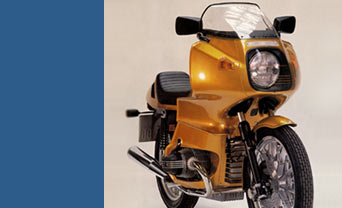
Long ago, in the mid-1970s, when the only motorcycles which carried low-ish handlebars and aerodynamic fairings were dedicated racers, BMW stunned the motorcycling world with the introduction of the R100RS. In one fell swoop, a motorcycle capable of cruising comfortably at over 100 mph for hours on end with enough cargo capacity to be able to do it for a week or two on the road, created a whole new genre of bike: the sport tourer.
Described variously as a "jack of all trades," a sport tourer is not a sportbike, as it doesn't have the raw straight-line performance nor ground clearance. It is not a cruiser, for it hasn't the flashy paint and acres of chrome. It's not an interstate tourer, with the sybaritic hedonism uber alles and massive scale of that sort of thing. Nor is it a really good in-town commuter or grocery getter, because wide, tall saddles and 550 pound wet weights can be clumsy and too bulky for the cut and thrust of urban traffic flow.
A sport tourer is a wonderful compromise. It might not be the best at any specific task, yet the rider who wishes to participate in all of the things he might wish to indulge in, from scratching around on secondary two-lane roads, blitzing up the interstate, or grabbing nearly a week's food at Safeway, while owning only one bike--well, you know who you are.
As a Beemer loyalist, I've owned an example of each of the three generations of RS motorcycles, and have ridden them well over 100,000 miles. I'm also honest about them; rarely do Beemer folks buy their bikes because they love the way they look. It's much more a left-brain acquisition. They have always gone their own way in terms of styling, and the R100RS was really the second bike in a product expansion that continues to this day. The first was the 1974 R90S café-faired multi-hued sportster that changed BMW from a purveyor of stolid, gentlemanly tourers to a more youthfully focused marketing basis.
The RS's nom de guerre is a wind tunnel tested fairing, a frame-mounted "Integral Cockpit" designed to reduce rider fatigue from wind pressure. This was not simply a nearly vertical Plexiglas shield a la Electra-Glide, but a fiberglass-reinforced envelope that covered the rider virtually from foot to neck in still air. Around the height of the top of the front wheel, it featured small down force-inducing strakes to increase stability at high speed, a flush glass headlight cover with heat-sensitive defroster lines printed onto its surface, and a broad cross-section that covered the rider's hands and arms in conjunction with the very narrow (21") handlebar.
Carrying 6.1 gallons of fuel, with a choice of a racy-looking "3/4 solo" seat with a wedge-shaped under seat storage compartment, or the comfortable dual saddle from the older "S" model, along with removable and lockable Krauser saddlebags, the "Airhead" RS was a gentleman's express. A bike to squash long distances at high speed with comfort and reliability, and it was absolutely unique in the marketplace at the time.
With only minor changes, the RS continued in production until 1988, though limited-series re-releases occurred into the early '90s. By then the old Airhead had been "replaced" by the 1985-1990 K100RS liquid-cooled fours due to smog regulations that sapped their power. Later BMW introduced the K1100/K1200 fours with four-valve induction, and the Oilhead R1100/1150. These were produced from 1994 to 2004.
The K-model fours are interesting in that BMW felt it had to maintain a unique engine layout from a marketing perspective. So the longitudinal (rather than transverse per the Japanese idiom) mounted engine, automotive in its design philosophies due to liquid cooling, fuel injection, exhaust and mechanical sounds, weight and complexity, was what BMW wanted to move its riders into the future.
The K100RS was the first series production motorcycle to have a really powerful charging system, capable of powering all the electric heated clothing, lighting accessories and what have you any sane rider might want. They received optional antilock braking in 1988, and they are very nearly perpetual motion machines, commonly racking up six-figure odometer readings before needing any major engine servicing.
BMW did try to centralize mass; one look at the motor and transmission housings, all in light alloy, with the swingarm pivoting from the tranny case, as well as an alloy fuel tank and lightweight wheels, provides some clues to this. However, these bikes are tall, especially the first-year 1985 models, so much so that the seat and rear tail housing was redesigned/lowered only one year later. Their center of gravity was noticeably taller than the old twin. Thus their low-speed handling suffered because of the stack height of all that hardware, along with a largish 5.8 gallon tank.
Engine heat was also a real issue in warmer climes. The RS fairing had always been a bit of a heat-sink, trapping the rider's legs and broiling them, and the liquid-cooled K was worse than the air-cooled twin. Neither was a lot of fun in summer traffic. For these reasons, many riders have preferred the opposed twin that began the BMW design ethic back at the beginning of their motorcycle production in 1923.
For the 1994 Oilhead twin RS, so nicknamed because of the use of oil as a supplemental heat exchanger, BMW used the torque canceling Paralever rear shaft drive. This nearly eliminates shaft-induced rise and fall from the later K-Series fours. Also featured was the Integrated Drive Concept of motor, trans, and attached rear swingarm suspension and something new, the Telelever.
Telelever is in essence an A-arm, pivoting from the crankcase of the bike, with a cast alloy steering pivot also bolted to the top of the crankcase, suspended by a single shock sandwiched between the headstock and A-arm. The front of the A-arm features a spherical bearing which permits the long fork legs, which have nothing in them besides lubricating oil, steering motion and the ability to rotate with upward suspension movement.
The reason behind Telelever is to be able to separate the forces of steering, braking, and suspension action. Conventional telescopic forks in motion change a bike's steering geometry, reducing the apparent rake and trail because they operate in a diagonal direction when absorbing bumps or while braking, which can cause instability. Telelever allows the front wheel to travel nearly vertically during suspension travel, and provides nearly sixty percent less dive when on the brakes.
In action, Telelever is far more plush than a conventional fork, while still offering a fairly well controlled and damped ride quality, and the bike won't stand up under braking. Due to the bodywork that covers much of the A-arm, from a marketing perspective, Telelever is far and away the most sales-successful "alternative" front suspension extant because it looks comfortingly conventional. It also requires no routine maintenance and can be improved by simply bolting up another single shock, depending on the ride and handling characteristics that you want. No mucking about with "bottoming kits," cartridge emulators, fork springs, or any of the stuff necessary to make even a good conventional fork work under the myriad of road conditions and rider biases to which a sport tourer might be subjected.
If one peeled away the bodywork from an Oilhead Beemer, you would see a chassis that is, essentially, the engine, with front and rear suspension attached to it. Not only does this scheme make the engine a "stressed member," it radically simplifies and potentially lightens a large displacement motorcycle. By way of comparison, Honda's VFR750 was really no lighter than this more fully faired, hard saddlebag and ABS equipped Oilhead RS, so the advantage was real.
Downsides to all three RS models include windshields that direct dirty air buffeting directly at the rider's helmet, so much so that one of the most likely modifications one will see on an RS that's being ridden a lot are either higher windshields, higher handlebars to move one away from the shield, or both. This buffeting is not only fatiguing on a long trip, but if ridden all day without earplugs, will accelerate hearing loss beyond that experienced by an unfaired bike's rider.
Interestingly, the seats on both the K-Series and the Oilhead R-Series are pretty bad. The bikes are still built more for tall Germans than they are for 85thpercentile Americans.
First generation "Airhead" bikes have problems with detonation because of the leaner mixtures required by the anti-pollution Nazis, and high compression. In 1981 BMW went to Nikasil cylinder plating and lowered compression from 9.8:1 down to 8.2:1, which sapped power.
In 1985 they lost their 40mm Bing carburetors in favor of small 32mm units that dropped the power even further. They are also difficult to start in cold weather, and require trickle charging to maintain the large battery even in good climes.
The 280 watt (nominal) rating alternator is insufficient to maintain a heated vest when running below highway speed, and the early 1976-1980 bikes still used point and condenser ignition, requiring periodic tuning and replacement. Cylinder heads need to be retorqued and rocker arm end shake needs to be adjusted out during each tune-up regimen involving valve adjustment. Carburetors need to be synchronized for smooth running. There is also a problem with valve seat recession that the company never really dealt with well, due to the loss of lead additives that provided some amount of cushioning when the valves closed on their relatively soft seats.
The earlier 1985-1989 K's have some servicing issues. Early K-Jetronic injection systems need to be looked after for emissions, and their slow throttle response, due to the large butterfly valve intake plenum, means they don't rev much faster than the twins, even though they're fours.
Air filters are hard to remove and replace, and fuel filter replacement requires fuel-tank removal. Valves are shim over bucket adjustment and are thus easy, plus they seldom change due to the quality of the materials of the valves and seats. Pre-1986 bikes did not have pinned oil control rings, and tended to smoke quite a bit if left parked on the sidestand for any length of time.
1991 and later K100/K1100/K1200 have four valve cylinders and the entire bucket needs to be swapped out for valve clearance maintenance. These are pricey, but fortunately aren't often done. What you will pay for is camshaft removal to get to them.
The newer bikes had Bosch Motronic engine management, and perform better and rev faster, yet K-Series bikes never had "snappy" and precise handling as they came from the factory. In my experience, even with after market componentry front and rear, the bike's tallish weight distribution and 60-plus inch wheelbase means it's more an autobahn blaster with great straight-line stability, rather than something one would take on tight and twisty roads for fun.
The last K12RS has Telelever and automotive quality electronic cruise control, but I found it lacked steering feel. To me that is an absolute no-no on a bike meant to explore places with which you might be unfamiliar. With an even longer wheelbase and more weight than my old '89 RS-ABS "Special," it is not really a good choice for the smaller statured among us. Finally, the K's all had rather heavy throttle return springs, and it got worse with the last K12s because the cruise control added a THIRD throttle cable and spring that your wrist had to twist.
1994 first year Oilheads have rattly transmissions at idle. This is caused by the use of end bearings in the transmission case that cannot be tensioned to remove end play. In 1985 BMW changed the case, the case cover, the bearings, and added O-rings to the transmissions to quiet them down. They don't affect durability one iota, though.
All Oilheads suffer from lean surging at lower RPMs in lower gears; mine was most noticeable at about 30-40mph in third gear, 2000-2800rpm. It was not really bothersome, though the press surely pilloried the bike because of this quirk. There are ways to mitigate it by tuning, but mostly I just went a tad faster and was out of the zone, which also makes your cam chain last longer by not lugging the engine. The bikes are more complex than an old Airhead two-valver, but are actually easier to maintain due to the suspension, head and valve train design, and air and oil filter placements.
Finally, all BMWs consume some oil, and more notably, have a high road speed vibration issue. Twins merely increase in amplitude, they shake more, whereas the Fours increase in frequency, which feels like a buzz in your hands. Obviously as RPMs go up, frequency goes up too, but vibration is a balance factor inherent in the engine design, a compromise made by the engineers to allow for "smooth" running at expected velocities. While one can carefully tune the motor, carbs and throttle bodies, ensure that engine mounting bolts are torqued correctly, even fit a reduced back pressure exhaust, vibration cannot be eliminated. It can be a fatigue factor if you ride at over 100 mph for an extended period of time, as BMW riders must occasionally be able to do in Germany, where the bikes are made.
Of the three types I've owned the Oilhead was by far the superior mount. Easy to maintain, bodywork held by just a few--rather than a few dozen--screws, quieter, faster, good handling, fuel economy in the mid to upper 40s, and with no engine heat to speak of. They are also relatively inexpensive on the used market. Light enough to be a willing accomplice on back roads, yet with enough presence to work on the interstate, power and handling are nicely balanced.
The just announced R1200ST now features an Oilhead opposed twin with a balance shaft, reduced weight, and the name change that seems to signal an end to a glorious lineage that have provided myself and thousands of others many wonderful years of riding memories. One can only hope that it works darn well, as it has quite a reputation to live up to.
Related Posts Plugin for WordPress, Blogger...

You May Like to Visit

Follow us on Facebook

Fb Comment